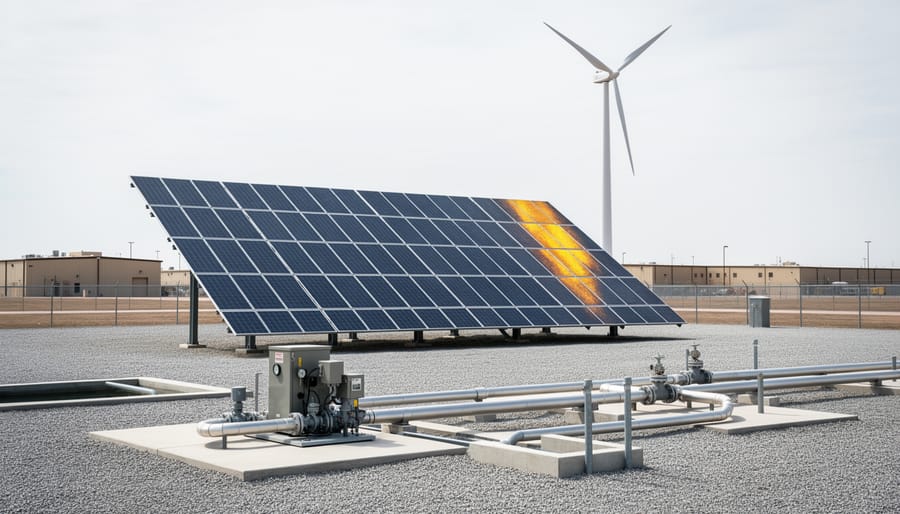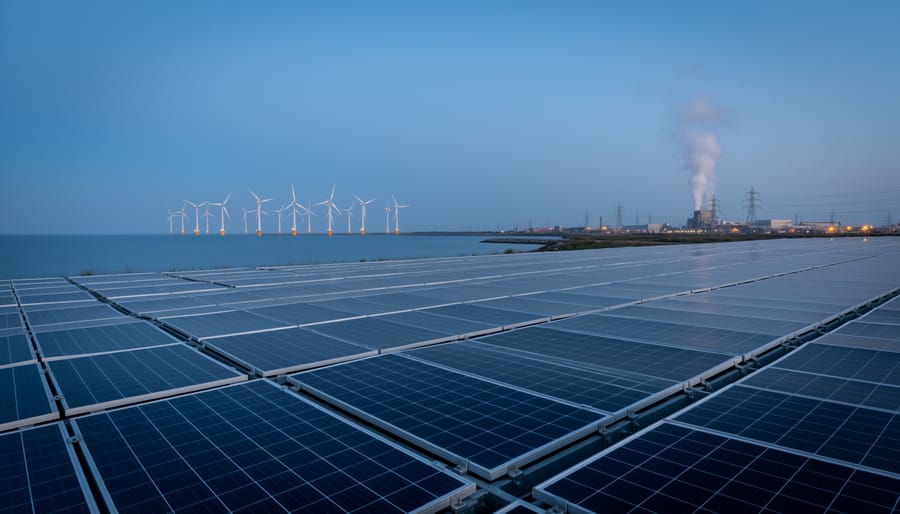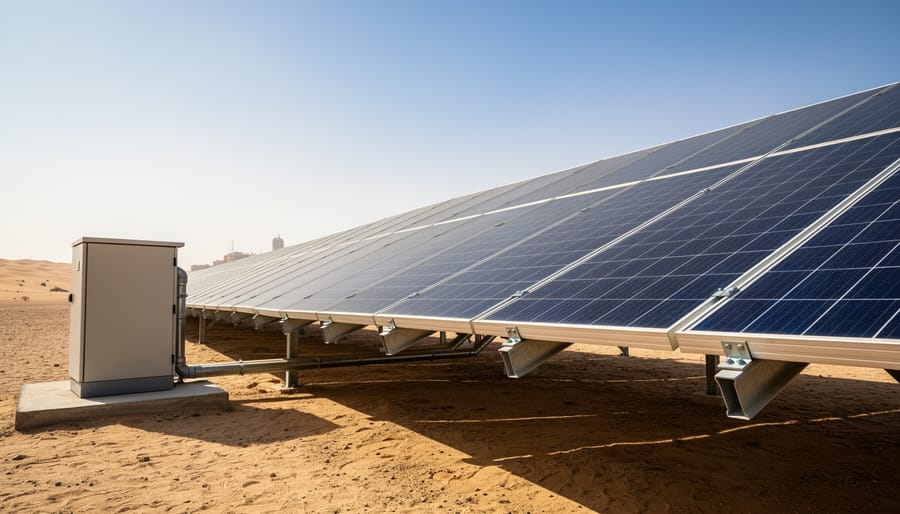
Optimizing solar energy systems in Oman requires a structured approach that accounts for the Sultanate’s exceptional solar irradiance, ambitious renewable targets, and extreme temperature variations. With Oman committing to derive 30% of its electricity from renewables by 2030 and reduce greenhouse gas emissions by 7% within the same timeframe, professionals responsible for implementing photovoltaic installations must balance technical performance with regulatory compliance and long-term cost-effectiveness. The optimization process centers on three critical phases: site-specific resource assessment using verified meteorological data, system design that maximizes efficiency under high-temperature conditions, and grid integration strategies that align with national infrastructure standards.
Oman’s solar potential is substantial. In regions like Nizwa, daily sun radiation averages between 5,500 and 6,000 Wh/m² during peak summer months, with nine hours of daily sunshine and temperatures reaching 43°C. These conditions create both opportunities and engineering challenges. High irradiance levels promise strong energy yields, but elevated ambient temperatures reduce photovoltaic module efficiency and accelerate degradation if systems are poorly designed. Real-world implementations, including a 9-kW grid-connected system deployed in Nizwa using real-time performance data, demonstrate that carefully calibrated installations can deliver reliable output while meeting government mandates.
The growing momentum behind industrial energy partnerships and renewable MOUs has accelerated solar deployment across commercial and industrial sectors. For engineers, sustainability managers, and procurement specialists tasked with justifying investments, optimization is not optional. It determines whether a solar installation meets promised performance benchmarks, achieves payback targets, and contributes meaningfully to corporate sustainability goals while supporting Oman’s broader energy transition.
Understanding Oman’s Solar Energy Potential
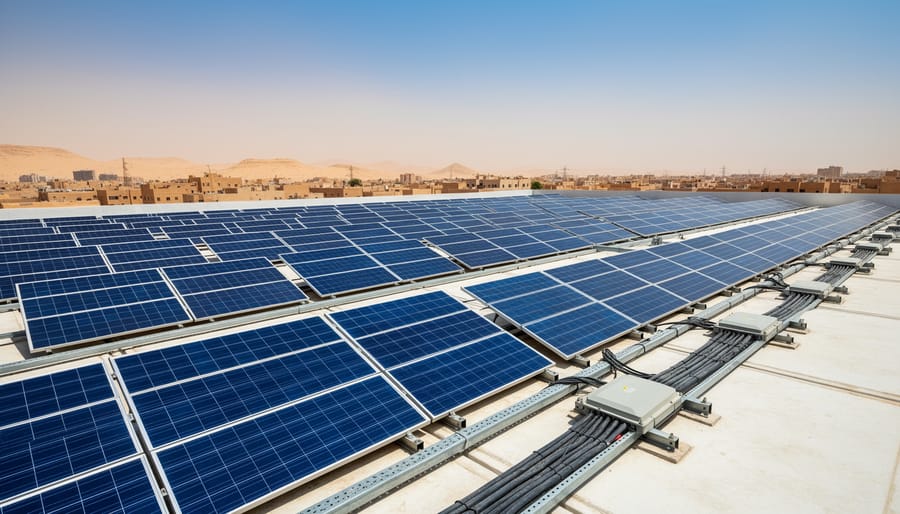
Oman’s geographical position and climate create exceptional conditions for solar energy generation, positioning the country among the region’s most promising markets for photovoltaic deployment. Understanding these resource characteristics is fundamental to effective system optimization, as they determine both performance potential and the technical adjustments required to achieve maximum efficiency.
The sultanate receives abundant solar radiation throughout the year, with measurements from Nizwa demonstrating peak daily sun radiation averaging between 5,500 and 6,000 Wh/m² during July. This high irradiance translates directly to generation capacity, but also demands system designs that account for intense exposure. The consistency of this resource is equally important, Nizwa records an average of 9 hours of sunshine per day, providing a reliable foundation for capacity planning and return-on-investment calculations. These figures, drawn from climatic data from stations across Oman, establish the baseline performance expectations that optimization efforts must leverage.
Temperature variations present both opportunity and challenge. Nizwa experiences summer maximums reaching 43°C, which reduce photovoltaic efficiency through thermal effects on panel output. Winter lows of 12°C in January offer better conversion efficiency but shorter daylight periods. This 31°C temperature range means optimization must incorporate cooling considerations, appropriate panel specifications rated for high-temperature operation, and performance modeling that accounts for seasonal efficiency shifts. Industrial-scale systems ignoring these thermal dynamics will underperform despite Oman’s excellent radiation levels.
These factors combine to make solar energy optimization not merely advantageous but necessary. The resource is abundant enough to justify investment, yet the environmental extremes require deliberate design choices. Projects that treat Oman’s conditions as generic Middle Eastern solar deployment will sacrifice 15-20% of potential output. Proper optimization transforms Oman’s solar resource from theoretical potential into reliable, cost-effective generation that supports both operational goals and the national target of 30% renewable electricity by 2030.
Essential Requirements for Solar Energy Optimization
Before launching any solar energy optimization project in Oman, assembling the right resources and expertise determines whether your implementation succeeds or stalls. The optimization process demands precision measurement tools, accurate environmental data, and thorough regulatory knowledge, skipping any component compromises system performance and return on investment.
Real-time data collection forms the foundation of effective optimization. Unlike generic solar calculations that rely on averages, successful projects in Oman’s variable climate require site-specific measurements. The Nizwa case study demonstrates this principle: designers collected actual solar radiation data showing daily averages between 5,500 and 6,000 Wh/m² in July, alongside temperature extremes from 12°C in January to 43°C during summer. These precise measurements enabled accurate system sizing and performance projections that match operational reality.
Your optimization toolkit must include specialized equipment and documentation:
- Solar irradiance meters (pyranometers) for measuring site-specific radiation levels throughout seasonal cycles
- Temperature sensors to record ambient and potential panel operating temperatures
- Grid connection specifications and technical requirements from your local electricity distribution authority
- PV system design software capable of modeling Oman’s high-temperature, high-irradiance conditions
- Historical weather data for your specific location, including sunshine hours, cloud cover patterns, and dust event frequency
- Regulatory compliance documents confirming alignment with Oman’s renewable energy framework and 2030 targets
- Qualified electrical engineering expertise with grid-connected solar system experience in Gulf climate conditions
Data collection should span at least several months to capture seasonal variations. In Nizwa, for instance, average sunshine reaches 9 hours daily, but this varies throughout the year. Recording these fluctuations allows you to design systems that perform efficiently during both peak summer production and lower winter output periods.
The regulatory documentation component deserves particular attention. With Oman’s commitment to achieving 30% renewable electricity by 2030 and reducing greenhouse gas emissions by 7% within the same timeframe, compliance requirements continue to evolve. Securing current grid connection approvals and understanding technical standards before purchasing equipment prevents costly retrofits later.
Investing in comprehensive upfront data gathering might extend your project timeline by several weeks, but the precision it enables translates directly into optimized system performance and faster payback periods.
Critical Considerations and Safety Requirements
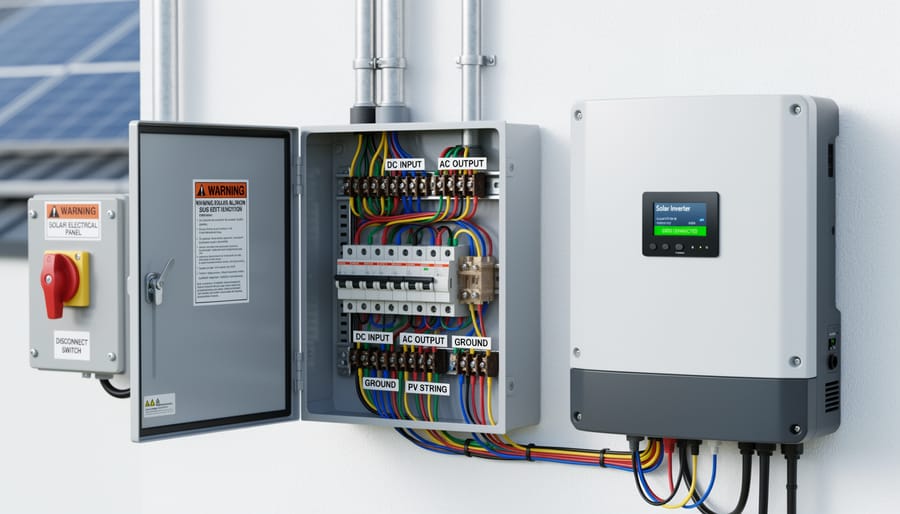
Before deploying any solar energy system in Oman, you must address critical safety and regulatory requirements that protect both personnel and infrastructure. Electrical hazards pose the most immediate risk during installation and operation. Grid-connected systems require strict adherence to voltage standards, proper earthing protocols, and protective devices that disconnect the system during grid failures. Never attempt installation without qualified electrical personnel who understand both DC and AC electrical systems, solar arrays can generate lethal voltages even in partial sunlight, and improper wiring creates fire hazards that persist throughout the system’s lifespan.
Oman’s extreme temperature range demands specific structural and environmental precautions. With summer temperatures reaching 43°C in regions like Nizwa, mounting structures must withstand thermal expansion while maintaining secure panel attachment. Roof installations require structural engineering assessment to verify load-bearing capacity, solar arrays plus mounting hardware typically add 15-20 kg per square meter, and wind loads increase this stress significantly. Flat roofs need ballasted systems designed for Oman’s occasional high winds, while sloped installations must account for both dead load and uplift forces.
Environmental factors unique to Oman’s climate affect safety planning. Dust accumulation reduces panel efficiency but also creates slip hazards during maintenance. Access pathways and fall protection systems become mandatory for rooftop installations, particularly since cleaning schedules intensify in dusty conditions. High ambient temperatures increase the risk of heat exhaustion for installation crews, schedule outdoor work during cooler morning hours and ensure adequate hydration protocols.
Regulatory compliance extends beyond technical specifications. Your system design must align with Oman’s renewable energy framework and the national target of 30% renewable electricity by 2030. Obtain all required permits before procurement begins, as post-installation modifications to achieve compliance prove costly and time-consuming. Halt implementation immediately if you encounter underground utilities during site preparation, grid connection parameters that exceed your design specifications, or structural concerns during mounting installation. Consult certified specialists rather than improvising solutions to these critical issues.
Step-by-Step Solar Energy Optimization Process
Step 1: Collect and Analyze Local Solar Resource Data
Accurate solar energy optimization begins with collecting at least twelve months of site-specific meteorological data before system design. This baseline period captures seasonal variations that directly influence system performance and investment returns. Industrial decision-makers who skip this step often underestimate or overestimate generation capacity, compromising project economics.
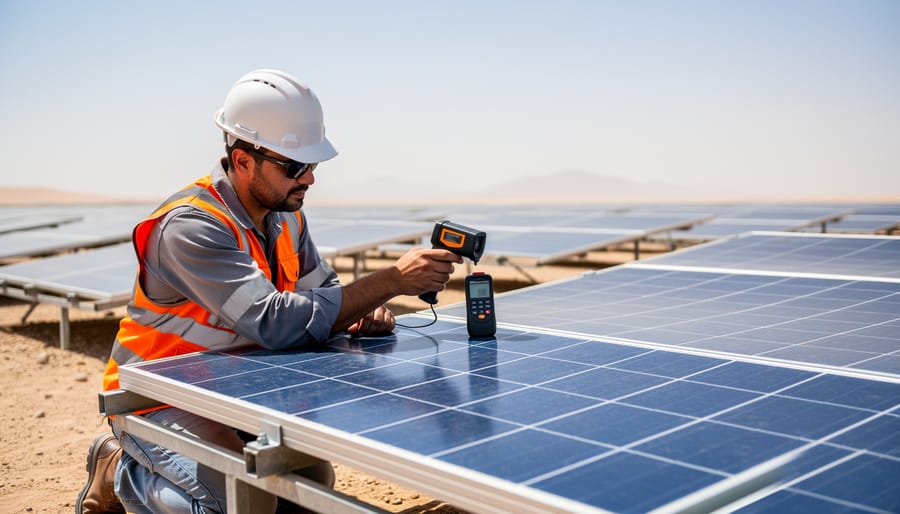
Install calibrated pyranometers to measure solar irradiance at your exact installation site, not regional averages. Track global horizontal irradiance (GHI), direct normal irradiance (DNI), and diffuse horizontal irradiance (DHI) in Wh/m² at hourly intervals. The Nizwa case study demonstrated why local measurements matter: daily summer radiation reached 5,500 to 6,000 Wh/m², with consistent 9-hour sunshine periods, but temperature extremes from 12°C in January to 43°C in summer created performance variations that generic data couldn’t predict.
Simultaneously monitor ambient temperature, wind speed, humidity, and dust accumulation rates. These parameters explain efficiency losses and inform cooling strategies. Record data continuously through your logging system, flagging any sensor malfunctions or measurement gaps immediately.
Validate your dataset by cross-referencing with nearby meteorological stations for consistency, checking for anomalies that suggest equipment errors, and confirming that seasonal patterns align with Oman’s known climate characteristics. Clean, verified data from your specific location forms the foundation for accurate system sizing, performance modeling, and realistic ROI projections. Companies that invest in thorough data collection before design consistently achieve closer matches between predicted and actual system output.
Step 2: Calculate Energy Requirements and System Sizing
Start with your historical electricity consumption data to establish a baseline demand pattern. Review at least 12 months of utility bills to identify seasonal variations and peak usage periods. Calculate your average daily consumption in kilowatt-hours (kWh), noting how demand fluctuates between summer cooling loads and winter requirements. This consumption profile determines the minimum system capacity needed to achieve meaningful energy offset.
Analyze your load profile by time of day. Document when electricity demand peaks, typically during business hours for commercial facilities or afternoon cooling periods for industrial operations. Solar generation peaks at midday, so systems perform best when your consumption aligns with available sunlight. If most of your energy use occurs after sunset, size your system conservatively since grid-connected installations without storage cannot shift generation to match evening loads.
Assess your available installation area using actual measurements. Rooftop systems require approximately 6-8 square meters per kilowatt of capacity, depending on panel efficiency and mounting configuration. Factor in shading obstacles, structural load capacity, and access requirements for maintenance. A 9-kW system, appropriate for many small commercial applications in Oman, needs roughly 54-65 square meters of unobstructed south-facing space and can generate approximately 40-45 kWh daily under Nizwa’s average 9 hours of sunshine.
Balance system capacity against grid connection limitations. Verify local utility requirements for maximum allowable capacity based on your service connection rating. Oversizing beyond your consumption or exceeding grid interconnection limits creates regulatory complications without improving return on investment. Target a system capacity that covers 70-90% of your daytime electricity demand for optimal economic performance.
Step 3: Design the Grid-Connected PV System
With your system capacity determined, the design phase translates theoretical requirements into a functional grid-connected installation optimized for Oman’s operational environment.
Start with panel configuration by selecting modules rated for high-temperature performance. Standard silicon panels lose approximately 0.4-0.5% efficiency per degree Celsius above 25°C, a critical consideration when ambient temperatures reach 43°C during Omani summers. Choose panels with low temperature coefficients and verify their warranty coverage includes exposure to extreme heat. Arrange panels in series-parallel configurations that match your inverter’s voltage window while accounting for thermal expansion in mounting hardware.
Inverter selection determines system reliability and grid compatibility. Grid-tied inverters must synchronize with Oman’s electrical grid specifications, typically 230V single-phase or 400V three-phase at 50Hz. Select inverters with wide maximum power point tracking (MPPT) voltage ranges to maintain efficiency across temperature variations. Size the inverter between 100-110% of your DC array capacity to accommodate optimal power conversion without clipping during peak production hours. Ensure the unit includes built-in grid protection features, anti-islanding, voltage and frequency ride-through capabilities, required for safe grid integration.
Mounting system specification must address structural loads and thermal management simultaneously. Use aluminum or galvanized steel racking designed for wind loads typical in your installation area. Orient panels to face south for maximum annual yield, though slight east-west adjustments may optimize morning or afternoon generation to match load profiles. Maintain adequate spacing between panel rows to prevent shading while allowing airflow underneath arrays, critical for reducing heat buildup that degrades performance.
Electrical integration requires properly sized cabling, overcurrent protection, and isolation switches. Calculate wire gauge based on maximum current, run length, and acceptable voltage drop (typically under 3%). Install DC and AC disconnect switches accessible for maintenance and emergency shutdown. Coordinate grid connection requirements with your local utility, confirming metering arrangements and interconnection approval procedures before energizing the system.
Step 4: Optimize for Environmental and Operational Conditions
Oman’s temperature extremes, from winter lows of 12°C to summer peaks of 43°C, directly reduce photovoltaic efficiency, making climate-specific optimization essential. Solar panels lose approximately 0.4-0.5% efficiency per degree above 25°C, meaning systems in Nizwa can experience 7-9% efficiency drops during peak summer without mitigation measures.
Mounting systems should incorporate air gaps beneath panels to promote natural convection cooling. Tilt angles between 15-25 degrees optimize both energy capture and airflow for heat dissipation. Selecting panels with lower temperature coefficients minimizes performance degradation; monocrystalline modules typically outperform polycrystalline options in high-heat conditions where temperature affects PV performance significantly.
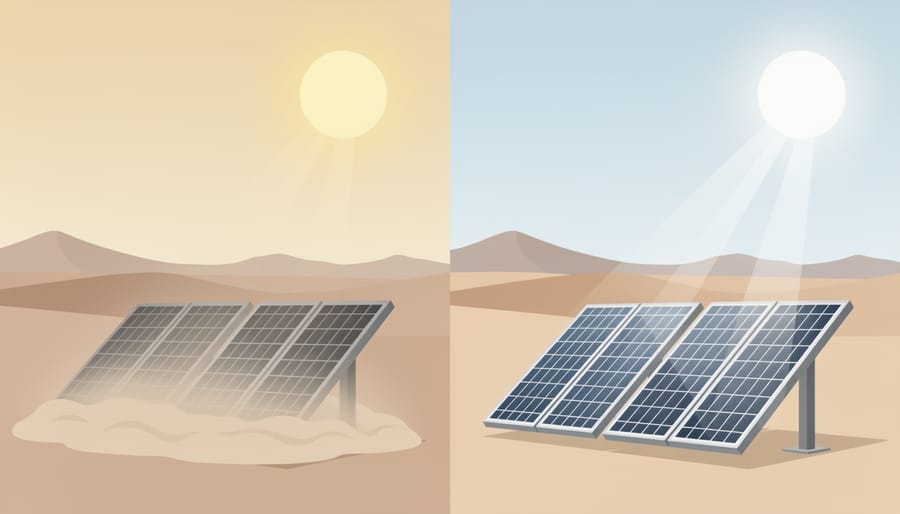
Dust accumulation poses a serious challenge in Oman’s arid climate. Establish monthly cleaning schedules during dry seasons, increasing to fortnightly during dust storm periods. Anti-soiling coatings reduce cleaning frequency by 30-40%. Position panels at minimum 20-degree tilt angles to leverage rainfall for natural cleaning when possible.
Inverter placement requires protection from direct sun exposure. Install inverters in shaded, ventilated enclosures to prevent thermal shutdowns. Oversizing inverters by 10-15% accounts for capacity degradation under sustained high temperatures. Monitor string voltages for temperature-related fluctuations that indicate suboptimal connections or component stress requiring immediate adjustment.
Step 5: Implement and Commission the System
Installation begins only after all grid connection approvals are in place. Coordinate with Oman’s distribution company to schedule the final grid interface installation and meter setup. Engage certified installers familiar with Oman’s high-temperature conditions to mount panels at the specified tilt angle, ensuring structural integrity and adequate ventilation clearance to minimize heat buildup. Complete all electrical connections according to approved design specifications, using properly rated cables, junction boxes, and surge protection devices.
Before energizing the system, conduct commissioning tests to verify proper function. Check panel polarity, measure open-circuit voltage and short-circuit current against manufacturer specifications, and confirm inverter communication with the grid. Test the system’s response to grid disconnection events to ensure safety compliance. Record baseline performance data during the first week of operation, tracking daily energy generation against expected output based on Nizwa’s 9-hour daily sunshine average, to establish your performance benchmark. Document all test results and obtain final utility sign-off before declaring the system operational. This validation confirms that optimization efforts translate into actual performance gains.
Performance Verification and Ongoing Optimization
Verification begins the day your system goes live and continues throughout its operational lifetime. Track daily energy yield against expected output based on Oman’s solar resource, a properly optimized 9-kW system in Nizwa should generate approximately 40-45 kWh on a typical day, with seasonal variations reflecting the 5,500-6,000 Wh/m² daily radiation. Monitor these key performance indicators weekly:
- Daily and monthly energy yield compared to weather-adjusted forecasts
- System efficiency ratio accounting for inverter and wiring losses
- Performance ratio against theoretical maximum output for your location
- Temperature-adjusted performance during Oman’s 12-43°C range
- Grid export and import balance to validate consumption offset
Schedule quarterly maintenance inspections focused on dust accumulation, electrical connection integrity, and inverter performance logs. Oman’s arid climate demands panel cleaning every 4-6 weeks during peak dust seasons to maintain optimal light capture. Annual thermographic scans identify hot spots indicating cell degradation or connection faults before they impact overall system output.
ROI measurement requires comparing actual electricity cost savings against projected baseline consumption. Most industrial installations in Oman achieve payback within 5-7 years when systems maintain 85% or higher performance ratio. Factor in avoided grid electricity costs at current commercial rates and any relevant sustainability credits when calculating returns. Industrial operations can extend this financial analysis across multiple sustainability initiatives, including water recycling for profit and wastewater treatment to demonstrate comprehensive environmental and economic benefits aligned with what renewable MOUs establish for national energy goals.
Trigger system adjustments when performance drops below 90% of expected output for three consecutive weeks, excluding documented weather anomalies. Document all interventions and their impact on subsequent performance to refine your optimization strategy continuously.
Frequently Asked Questions
How much solar radiation does Oman actually receive?
Oman experiences exceptional solar resource potential, with locations like Nizwa recording daily sun radiation averaging between 5,500 and 6,000 Wh/m² in July and approximately 9 hours of sunshine per day. These figures place Oman among the most favourable regions globally for solar energy generation, making optimization efforts highly cost-effective.
What system size is appropriate for commercial and industrial facilities?
System sizing depends on your facility’s electricity consumption profile, available installation space, and grid connection capacity. Real-world implementations in Oman range from 9-kW systems for smaller operations to multi-megawatt installations for industrial sites. Conduct a detailed load analysis and site assessment to determine the optimal capacity for your specific requirements.
How does extreme heat affect solar panel performance in Oman?
High temperatures, which can reach 43°C during summer months in regions like Nizwa, reduce solar panel efficiency by approximately 0.3-0.5% per degree above 25°C. Proper system design accounts for this through panel selection with better temperature coefficients, adequate ventilation, and mounting configurations that promote cooling.
How does solar optimization support Oman’s renewable energy targets?
The government plans to derive 30% of electricity from renewables by 2030 and has committed to reducing greenhouse gas emissions by 7% in the same timeframe. Industrial and commercial solar installations contribute directly to these national goals while delivering cost savings and energy independence for participating organizations.
These questions reflect the practical concerns that procurement specialists and sustainability managers encounter when evaluating solar investments. Beyond the technical and policy considerations covered here, successful optimization hinges on selecting experienced partners who understand both the engineering requirements and the regulatory landscape in Oman.
Grid connection procedures vary depending on your facility’s location and the utility provider serving that area. Work with qualified electrical engineers who have completed similar projects to ensure your system meets all technical specifications for safe, compliant grid integration. Documentation requirements typically include system design plans, electrical schematics, and commissioning test results.
The timeline from initial assessment to full commissioning typically spans three to six months for commercial installations, accounting for design, procurement, permitting, and installation phases. Industrial-scale projects require longer lead times due to equipment procurement and more complex engineering requirements. Planning your optimization project with realistic timelines prevents rushed decisions and ensures quality outcomes that deliver the performance and ROI your stakeholders expect.
Systematic solar energy optimization represents a convergence of environmental responsibility and operational efficiency for organizations in Oman. The methodology outlined in this guide translates national renewable energy ambitions into actionable steps that deliver measurable results. By following these proven practices, industrial and commercial facilities can contribute to Oman’s target of generating 30% of electricity from renewables by 2030 while simultaneously reducing operational costs and enhancing energy security.
The evidence from real-world implementations demonstrates that optimization is not theoretical. Systems designed with careful attention to Oman’s exceptional solar resource, regions like Nizwa receive up to 6,000 Wh/m² daily during peak months, achieve performance levels that justify capital investment through sustained energy generation. Organizations that embrace this approach position themselves ahead of regulatory requirements and market expectations, gaining competitive advantage through lower energy costs and credible sustainability credentials.
Success requires commitment to data-driven design, professional implementation, and ongoing performance management. The tools, processes, and verification methods presented here remove uncertainty from solar energy adoption. For decision-makers ready to move from evaluation to execution, the pathway is clear. Partner with experienced providers who understand Oman’s specific conditions and regulatory framework to ensure your optimization efforts deliver the full economic and environmental value that solar energy makes possible in this climate.